



A team of archaeologists and geophysicists from the National Institute of Anthropology and History (INAH), the National Autonomous University of Mexico (UNAM), and the Archaeology Research and Exploration (ARX Project) located what could be a possible funerary structure underground in the area where the Temple of the Nativity is located, in Teotitlán del Valle, Oaxaca.
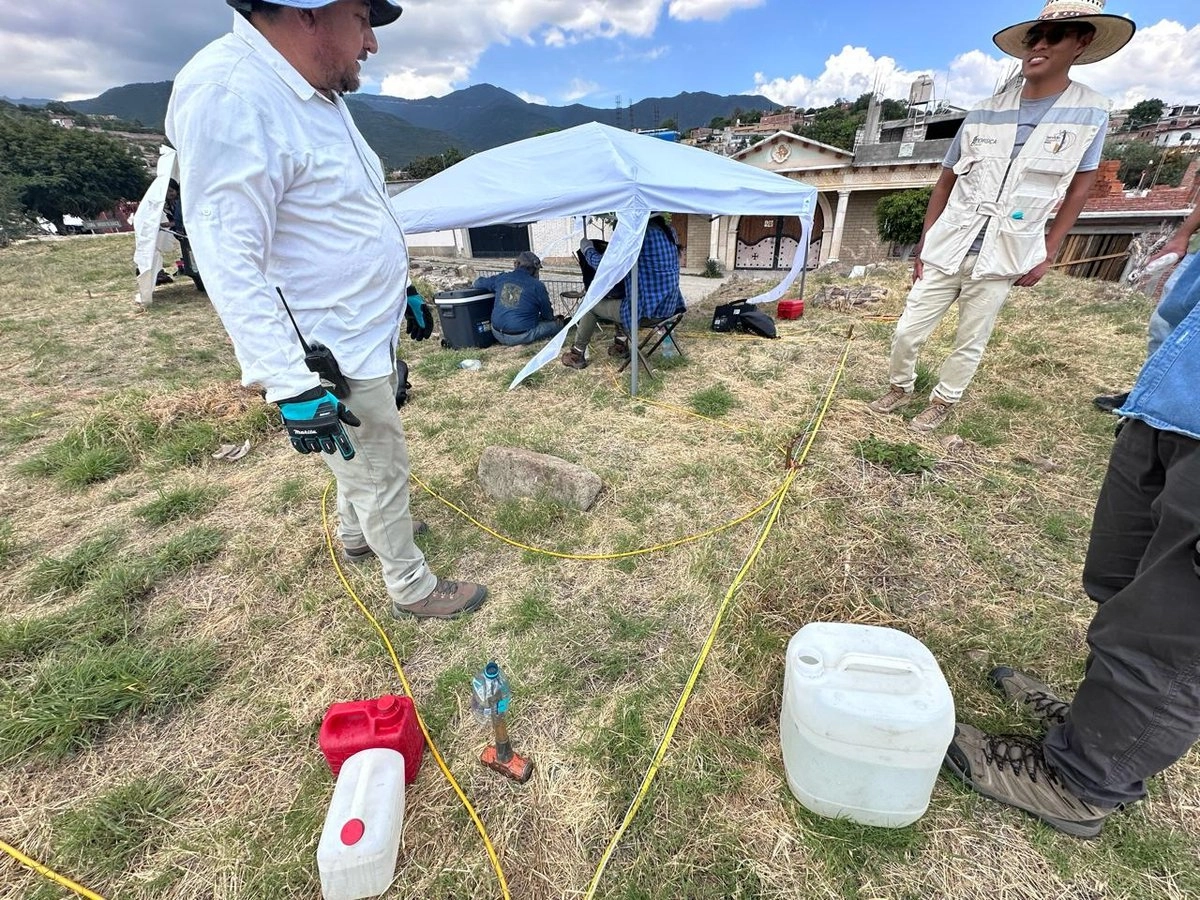
As in Mitla, the team carried out two phases of field study. In the first, they deployed a series of geophones around the perimeter of the Belguie-Xiguie sacred center; and in the second, they used Ground Penetrating Radar (GPR) in the municipal plaza, the atrium, and inside the church nave. Electrical Resistivity Tomography measurements were also taken at the archaeological site and surrounding temple areas.
Using geophysical techniques, they seek to recognize the subterranean layout of what is considered the cradle of Zapotec civilization. In 1995, during expansion works on the temple’s rear alley, a building was discovered with elements typical of Mitla-type architecture, characterized by a slope and the modulation of panels with fretwork. In 2019, the community and the INAH Oaxaca Center, under the coordination of Leobardo Pacheco Arias, head of the Tlacolula Valley Archaeological Corridor, restored the monument from the Late Postclassic period (1440-1521 AD).
Likewise, embedded stones with pre-Hispanic figures can be seen on the temple’s external walls, façade, and curacy, revealing that it was built on a Zapotec platform.
Preliminary readings from the first phase of the study, conducted by researchers Martín Cárdenas Soto and David Escobedo Zenil, revealed geophysical anomalies in the church, the atrium, and the archaeological site, which could indicate the presence of buried structures or chambers.
According to Denisse Argote Espino, an expert from the INAH’s Directorate of Archaeological Studies, the orchard area of the religious complex, where the aforementioned pre-Hispanic monument is located, was further explored in the second phase, which included the use of GPR, which she coordinated.
“Considering the previous results in Mitla, we detected what could be a plaza surrounded by four structures on each axis. In the tomography profile, in the center of the plaza, between 3 and 5 meters deep, we observed a geometry similar to the pattern of Zapotec tombs: an entrance that rises from the surface (perhaps a vertical staircase or descent), followed by a gallery within the rock, horizontally, crossing the plaza from east to west.
“Based on this and the resistivity values, which indicate that the fill of this element is more porous, we hypothesize the existence of a tomb or burial chambers, considering that some of these spaces are true family crypts of Zapotec ancestors,” he explained.
The use of geophysical methods for the non-invasive study of archaeological sites allows us to gain in-depth knowledge of the remains of ancient Zapotec centers in the Central Valleys of Oaxaca, which remain beneath urbanization, awaiting discovery. from specific excavations, the researcher concluded.
Source: jornada


