



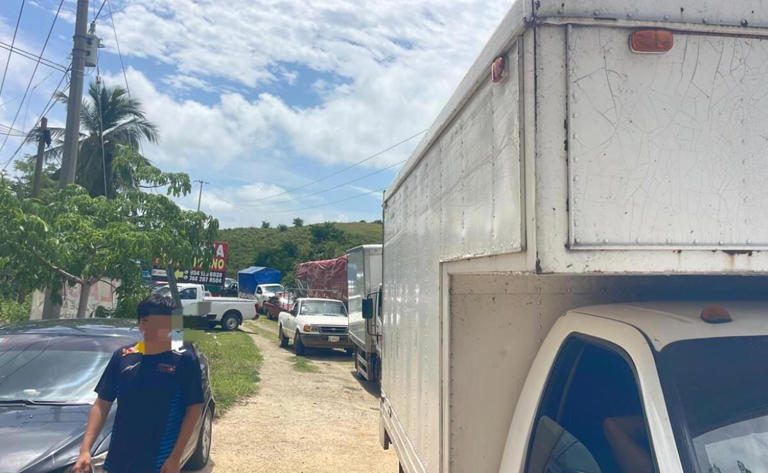
After failing to reach an agreement between Oaxaca state government officials and producers and farmers affected by Category 3 Hurricane Erick on the Oaxaca coast, they announced the complete closure of the Oaxaca-Guerrero Federal Coastal Highway 200; they requested the presence of President Claudia Sheinbaum.
After several hours of discussion at a working group on Thursday, August 14, producers and farmers from several communities on the Oaxaca coast affected by Hurricane Erick rejected the state government’s proposal for access to credit, stating that there is no way to repay it and that government support is minimal.
“It’s not fair that they always treat us like this, always with the same excuse that they don’t have money. We already know about the credit; we have to pay life insurance, among other things, and in the end, it’s more than what we owe and not what we’re going to invest in. For example, in my case, it’s not working. After the hurricane, I’ve been looking for them, but they haven’t given me an answer. Don’t leave us to die alone,” pleaded one of the producers affected by Hurricane Erick.
The producers have said that, since the hurricane hit on June 19, officials have only returned to conduct censuses, but afterward, they haven’t heard anything. Therefore, they are asking President Claudia Sheinbaum Pardo and her team to come and assess the producers’ conditions.
According to Víctor López Leyva, head of the Secretariat for Agri-Food Promotion and Rural Development (Sefader) of Oaxaca, 6,500 hectares of production were affected on the coast by Hurricane Erick.
“We’re left with nothing,” say the producers.
“We’re left with nothing. How are we going to reactivate production, the economy for our families?” asks a producer from María Morelos, municipality of Santa María Huazolotitlán.
This is one of the communities most affected by the hurricane in papaya, banana, lemon, and coconut crops.
They stated that some support has been limited to food supplies, and a few others have been limited to farm inputs, such as fertilizers. “But where are we going to use the inputs if everything has been lost—the harvest, the planting, everything?” asked Joel Silva.
He explained that the inputs did help a little during the effects of Hurricane John in November, because at that time, production was at a different stage. However, this time, due to the hurricane’s magnitude, it destroyed everything, even the little that had been recovered last November.
“With Hurricane John, at least we were able to grow something, but now with the passage of Erick, we’re left with nothing. We know it’s not the government’s fault, but it is their obligation to find ways to maintain the land, because it provides food for families,” they insisted.
Regarding the loan the state government is offering, they explained that it involves the purchase of insurance for 300,000 pesos, but that the government will only contribute 10 percent less. “Here, we all live on loans, but now that we’ve lost everything, how are we going to be able to pay that back?”
As of Thursday, Sefader has not announced the specifics of the credit support for those affected. It only announced the delivery of 365 packages of agricultural supplies to residents of Santiago Jamiltepec, San Gabriel Mixtepec, San Miguel Tlacamama, Santiago Pinotepa Nacional, Santiago Llano Grande, San Pedro Amuzgos, San Agustín Chayuco, San Pedro Atoyac, San Juan Colorado, and San José Estancia Grande, without specifying which communities.
In this situation, those affected, following a decision by the assembly and without a favorable response from Sefader, began the complete closure of coastal Highway 200, which connects Oaxaca with Guerrero, from Pinotepa Nacional to Villa de Tututepec.
They demand the presence of President Claudia Sheinbaum Pardo, “We are rural people, hardworking, and not conflict-ridden. However, with no favorable response, we find ourselves in need of this demonstration. Enough of this, when we are the major producers who support families on the coast.”
The communities affected by Hurricane Erika are primarily Afro-Mexican communities, recognized only in 2020. According to the INEGI (National Institute of Statistics and Geography), there are approximately 194,474 Afro-Mexicans in Oaxaca, or 4.7% of the state’s total population, making it the second state with the most Afro-Mexicans in Mexico.
Source: msn


